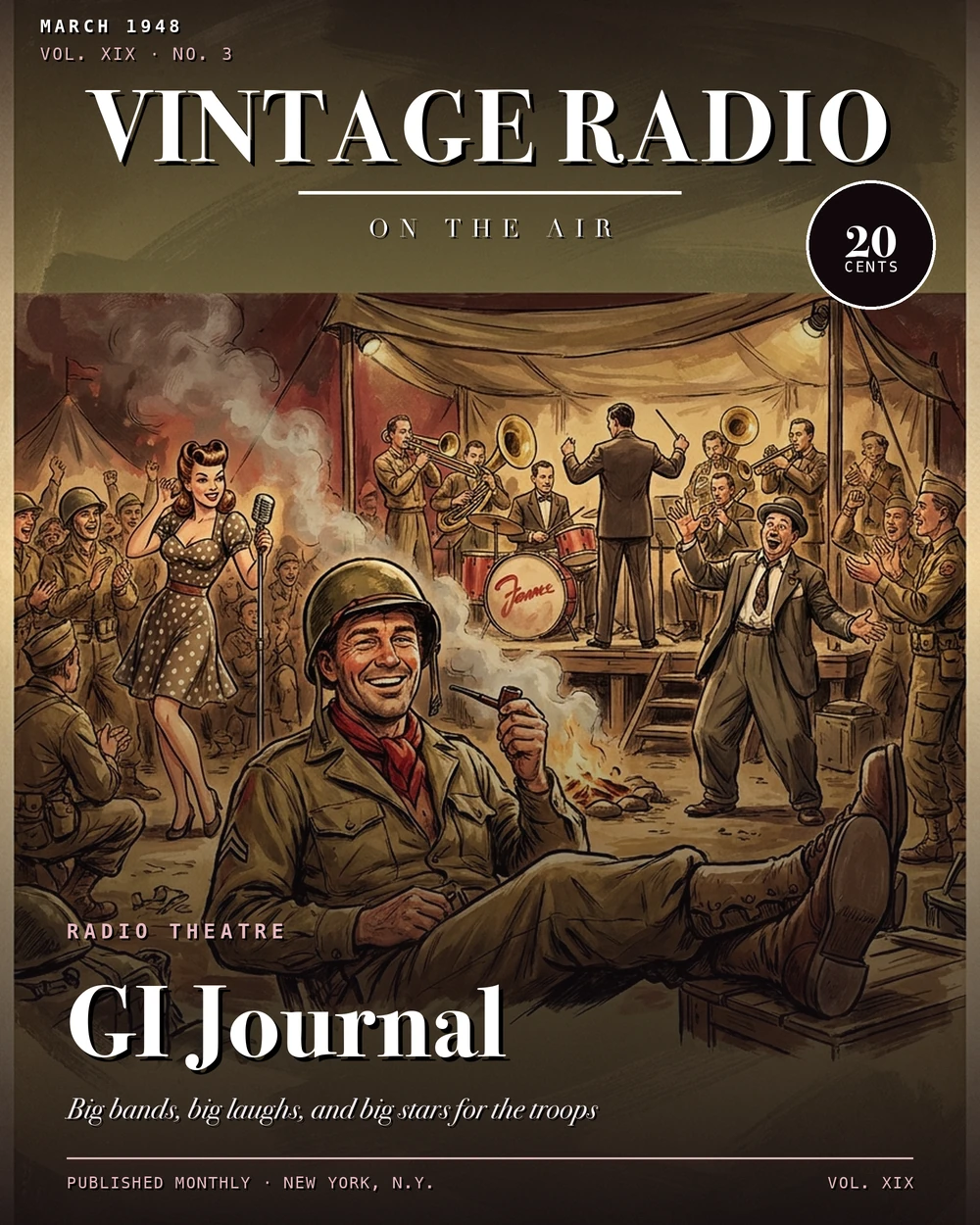
GI Journal
A Newspaper That Played Music
GI Journal ran from 1944 through 1946 over the Armed Forces Radio Service, the War Department's entertainment operation established in May 1942 and headquartered in Hollywood specifically to draw on the film and radio talent concentrated there. The show's central conceit was a military newspaper: each episode's celebrity guest was credited as "editor-in-chief," and the individual segments were introduced as "columns." That framing gave the variety format a structure that felt both familiar and a little tongue-in-cheek to servicemen overseas — the kind of joke that lands when everyone in the audience knows exactly what a real newspaper column looks like and how little the entertainment about to follow resembles one.
The show was a transcribed series, edited together from separately recorded segments rather than going out live. AFRS distributed it primarily via pre-recorded transcription disks mailed to stations in the various theaters of war, since shortwave transmission was considered too unreliable for regular broadcast. The result was a polished, assembled program that could reach GIs wherever they were stationed, carrying what the National WWII Museum has described as "a touch of home" and a counter to the isolation of overseas service.
Comedy and Music in Equal Parts
GI Journal is sometimes grouped with other AFRS music programs, but the format was more complicated than that. Trade-era sources consistently describe it as a combination situation comedy and variety show, with comedy skits running alongside the musical numbers rather than serving as brief filler between songs. The "military newspaper" structure made room for both, and the show used that space.
Big Band music was central to what GI Journal offered. Featured orchestras included Kay Kyser and His Orchestra, the Tommy Dorsey Orchestra, John Scott Trotter and His Orchestra, Mel Tormé and the Mel-Tones, and the Army Air Force Training Command Orchestra under Capt. Glenn Miller. One recurring segment gave GIs overseas a direct role in the programming: servicemen could write original songs that would be sent to Hollywood and performed by a studio singer on air. It was a simple idea, but it gave the show a feedback loop between the audience and the broadcast that most variety programs didn't have. Trade-era rankings placed GI Journal alongside Command Performance, Mail Call, and Jubilee as one of the top four AFRS shows of the war.
The Talent It Drew
Mel Blanc joined the show in 1944 as a regular, playing Private Sad Sack — a bumbling, stuttering Army private based on the popular wartime comic strip. It was the kind of recurring character that gave the show a spine between its rotating guest hosts, and Blanc played the role throughout the run. The guest list around him was substantial: Lucille Ball, Groucho Marx, Frank Sinatra, Orson Welles, Linda Darnell, Kay Kyser, Bob Hope, Edgar Bergen, Robert Benchley, and Fibber McGee and Molly all appeared across the catalog's five surviving episodes.
The Robert Benchley episode gives a sense of how the show was assembled. Benchley served as master of ceremonies alongside Blanc, Linda Darnell, Dick Aurandt, the Armed Forces Radio Orchestra, Allen Jenkins, Connie Haines, and Verna Felton, with Harry Mitchell announcing. That kind of ensemble — a mix of comedic and musical talent built around a guest host anchor — appears to have been the standard format, varied by whoever was filling the editor-in-chief role that week.
What Survives
Five episodes are held in the catalog, each a window into what GI Journal was doing at its peak. The guest hosts across those episodes — Bergen, Benchley, Welles, Hope, and Fibber McGee and Molly — represent a cross-section of the Hollywood talent the AFRS could draw on. The show sits comfortably in the company of the Andrews Sisters Show, the Bell Telephone Hour, and other programs from the same era that used music to entertain and lift audiences through difficult years. What sets GI Journal apart is the comedy running alongside it, the Private Sad Sack character giving each episode a recurring comic thread, and the soldier songwriting feature that put the audience inside the broadcast rather than just on the receiving end of it.